
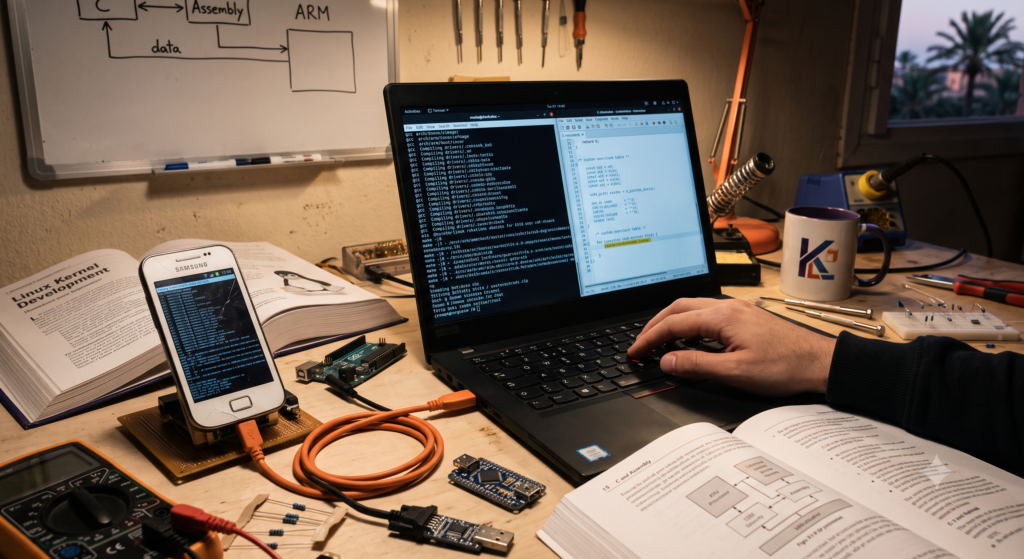
At the heart of every Android device, embedded system, and Linux server lies the kernel. It is the essential layer of software that acts as the bridge between raw hardware components—like the CPU, RAM, and sensors—and the high-level applications users interact with daily.
While most developers work within the comfortable boundaries of application-level code, modifying the Linux kernel offers an unprecedented level of control over hardware behavior, performance, and system optimization.
Here is a look at how kernel modification works conceptually, the core codebase structure, and the general workflow required to craft a custom kernel.
1. Navigating the Kernel Source Architecture
A Linux kernel source tree contains millions of lines of code, primarily written in C (~95%) alongside small, architecture-specific segments of ARM/x86 Assembly (~5%). Despite its massive size, the codebase follows a logical directory structure:
drivers/: The largest section of the codebase. It contains subdirectories for every hardware interface imaginable—displays, Wi-Fi modules, touchscreens, power management ICs, and sensors.arch/: Contains CPU-specific logic (e.g.,arch/arm/orarch/x86/). This is where the processor’s initialization routines, interrupt handlers, and assembly instructions live.kernel/: The core engine. It manages task scheduling, process lifecycles, and system calls.mm/: Dedicated entirely to virtual and physical Memory Management (RAM usage, paging, and swap).fs/: Defines File System support (ext4, FAT32, NTFS, F2FS).
2. Low-Level Configuration (make menuconfig)
Before writing a single line of C code, significant performance gains and system changes can be achieved through kernel configuration.
Using terminal configuration interfaces like make menuconfig, developers can visually audit and toggle built-in kernel features:
- Stripping Bloat: Disabling unnecessary drivers to drastically reduce the binary image size and decrease boot time.
- Enabling Advanced Modules: Toggling features like zRAM (compressed RAM memory) or customized CPU Governors (algorithms that control processor frequency scaling).
- Adding File System Support: Enabling read/write capabilities for non-native file formats.
3. Direct Source Code Modification
To introduce non-standard features—such as processor overclocking, custom thermal throttling, or specialized hardware controls—developers modify the core source files directly:
Frequency and Voltage Scaling (Overclocking/Underclocking)
Hardware clocks and operating voltages are typically defined in static arrays within device tree files or architecture-specific driver files (e.g., within drivers/clk/ or arch/arm/mach-...). Modifying these tables allows the kernel to push hardware beyond factory clock limits or drop voltages to conserve battery life.
Custom Logging and Tracing
Because standard C libraries like stdio.h are not available in kernel space, developers rely on kernel-level primitives such as printk() to log events directly to the system ring buffer. This provides vital diagnostic output during low-level execution.
4. Cross-Compilation and Hardware Target Execution
Kernels are rarely compiled on the target device itself. Instead, developers use a process called Cross-Compilation—using a high-powered workstation (x86_64) to build a binary targeted for a completely different architecture (such as ARMv6, ARMv7, or ARM64).
The general build sequence follows three primary steps:
- Exporting Environment Variables: Setting the target architecture and pointing to the designated cross-compiler toolchain:Bash
export ARCH=arm export CROSS_COMPILE=/path/to/toolchain/bin/arm-eabi- - Compiling the Image: Executing multi-core compilation to transform C source files into a unified kernel binary (such as
zImageorbzImage):Bashmake -j$(nproc) - Packaging and Flashing: Combining the compiled
zImagewith a initial RAM disk (ramdisk), creating a bootable image (boot.img), and flashing it to the physical target device via low-level flashing tools or custom recovery environments.
The Takeaway
Modifying a Linux kernel isn’t about reinventing the wheel; it is about taking direct command of hardware constraints. Whether the goal is bringing new life to legacy hardware, building customized embedded systems, or optimizing high-performance edge computing, understanding kernel internals transforms developer perception of how computers operate on bare metal.